---
title: "Release 13 “Adrastea”: ARM64, Kernel-less Images and a JavaScript SDK"
description: "ARM64 hosts and multi-platform builds, kernel-less images, elastic Kubernetes capacity through Karpenter, a JavaScript SDK, flexible networking, and a substantially expanded dashboard. Adrastea is the biggest release since we shipped GPUs."
doc_version: "1.0"
last_updated: "2026-09-02"
---
Release 13 "Adrastea" is out. With it, we are giving you a lot more flexibility to define your environment. You can now choose which architecture your hosts run, who provisions your nodes, who assigns your addresses, and which language you automate it all from.
## ARM64 support and multi-platform builds
The platform now runs on ARM64 hosts, across all supported Debian and Ubuntu releases. Everything behaves exactly as it does on x86-64, including the microVMs, the API and all tooling. Nothing changes for existing x86-64 deployments. You can place the same platform on ARM64 hosts to cut cost per instance, or to serve ARM64 workloads natively instead of emulating them.
The tooling is multi-platform to match: x86_64 and arm64 are equal citizens, with a single build covering both architectures.
## Kernel-less images
An image no longer has to bring its own kernel, it can boot with the kernel installed on the node. Also, A kernel security update doesn't require rebuilding every image anymore, since patching the node covers every instance on it. Images also get considerably smaller and faster to build, push and pull.
## A Karpenter provider for Unikraft
For Kubernetes-based customers, our Kubernetes integraion let a cluster schedule pods onto Unikraft, but the cluster still had to have the nodes to schedule them onto. The new Karpenter provider closes that loop! When a pod cannot be scheduled, a node is provisioned and joined to the cluster automatically, then removed again when the capacity is no longer needed.
For you this means Unikraft capacity is now elastic from inside Kubernetes, driven by the autoscaler you already run. New nodes arrive ready to work, with images pre-pulled and health verified before they take pods, and ARM and x86 nodes come from the same configuration. You pay for capacity when your workloads need it and hand it back when they do not.
## The JavaScript SDK
Unikraft Cloud now has an official JavaScript/TypeScript SDK([@unikraft/cloud](https://www.npmjs.com/package/@unikraft/cloud) on npm). Everything you can do from the dashboard or the API, you can now do with TypeScript. Create new instances, attach volumes, manage services and certificates, stream logs, etc.
Say you are building an AI agent product that spins up a sandbox per user session. With the SDK, your Node backend creates a microVM the moment a session starts, suspends it when the user goes idle, and wakes it in milliseconds when they return. The same goes for preview environments per pull request, per-tenant workloads, or scheduled batch jobs. If it runs on Unikraft Cloud, your JavaScript code can now orchestrate it directly.
## CNI, custom MACs, address-less interfaces
Network interfaces became considerably more flexible. A custom interface can now carry a caller-chosen MAC address. This means guests whose licensing, clustering or peer identity is tied to a MAC keep that identity when the instance is recreated. Interfaces can also be created without an IP address, for customers who manage addressing entirely on their own.
Custom networks can now also be considerably larger than before. So put simply, if you already have an IPAM system, a network fabric, or appliances with fixed identities, the platform now fits adapts to that.
R13 also adds CNI support. Your CNI plugin or IPAM system decides the addressing, and the guest configures itself to match, live and without any restarts.
## A big dashboard upgrade: ROMs, checkpoints and more
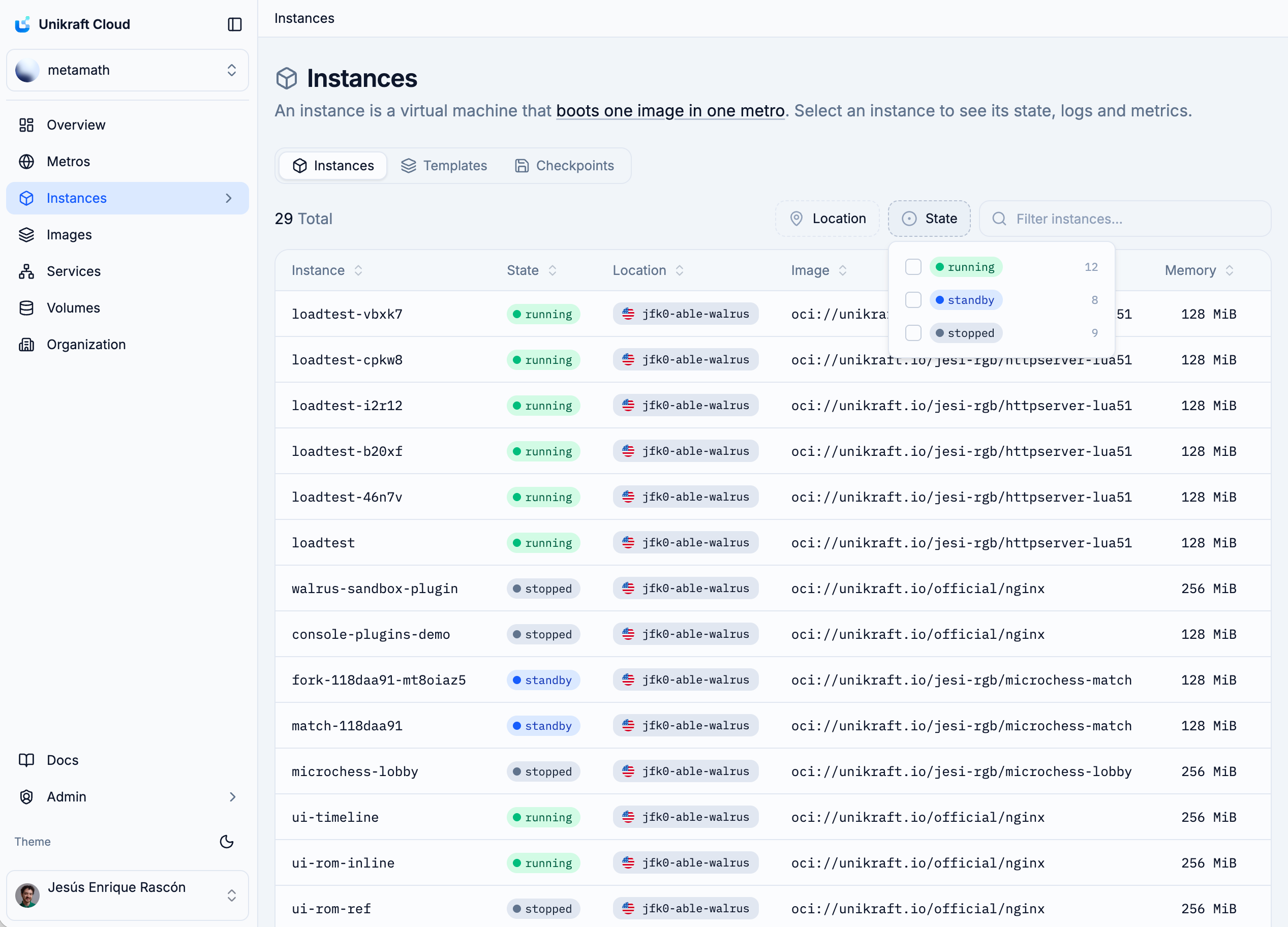
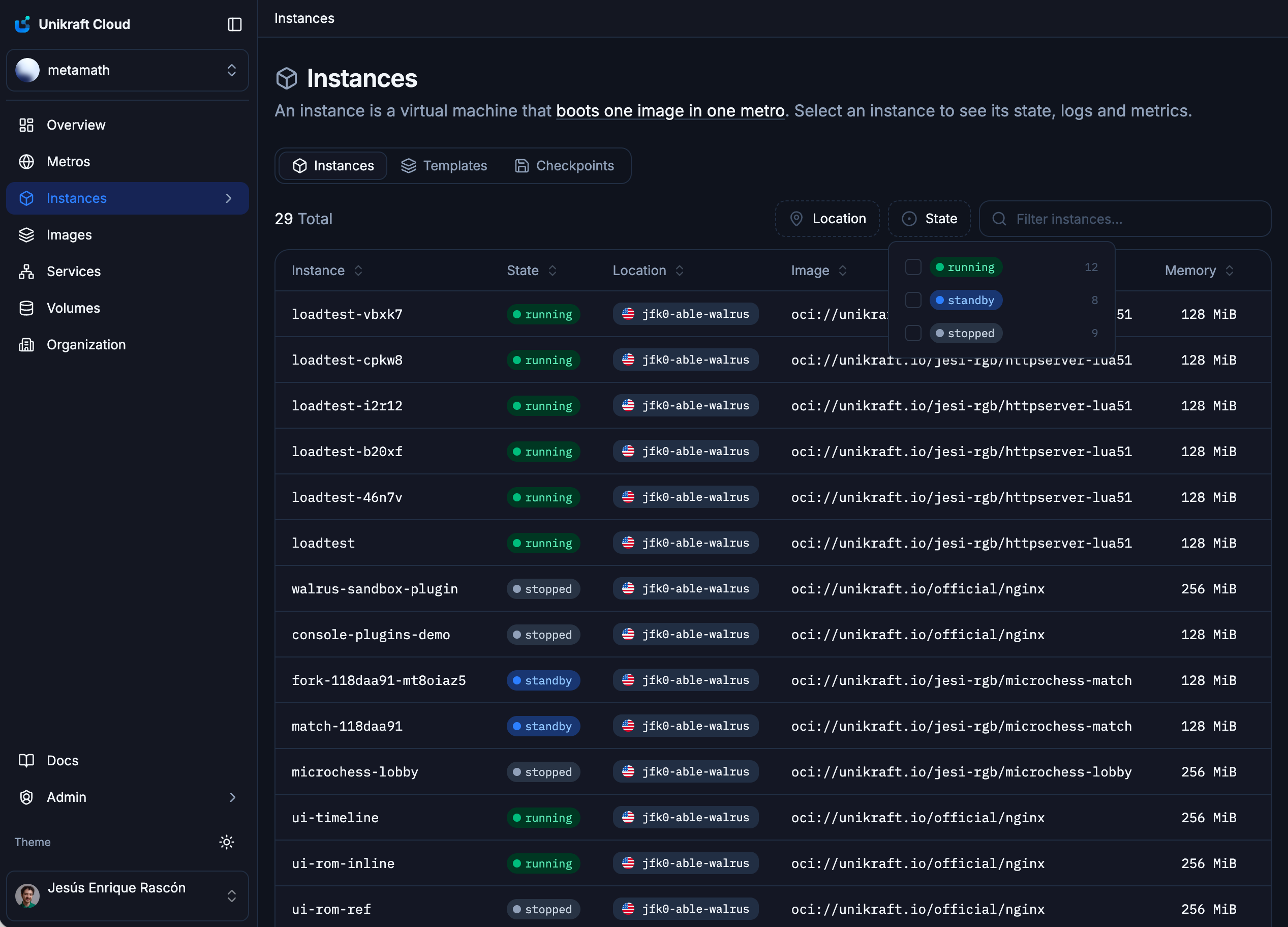
The dashboard gained its largest set of new capabilities yet. Every resource list now searches, sorts, filters and pages the same way. List states now live in the URL, so a filtered view can be bookmarked or sent to a colleague.
The dashboard also shows the objects that branching and checkpointing produce: instances gained templates and checkpoints views, each with a detail page. An instance's ROMs appear under its mounts tab.
On top of that, we always ship improved visuals, easier use, and quality-of-life tweaks.
 ## Everything else in Adrastea
## A sneak preview of what's next
A taste of what Release 14 has in store:
...and several others we are not listing, because we do not want to spoil all of the fun :)
## Sitemap
- [Home](https://unikraft.com/)
- [How It Works](https://unikraft.com/how-it-works)
- [AI](https://unikraft.com/ai)
- [Pricing](https://unikraft.com/pricing)
- [Customer Stories](https://unikraft.com/customer-stories)
- [Blog](https://unikraft.com/blog)
- [Documentation](https://unikraft.com/docs)
- [Glossary](https://unikraft.com/glossary.md)
- [Contact](https://unikraft.com/contact)
## Everything else in Adrastea
## A sneak preview of what's next
A taste of what Release 14 has in store:
...and several others we are not listing, because we do not want to spoil all of the fun :)
## Sitemap
- [Home](https://unikraft.com/)
- [How It Works](https://unikraft.com/how-it-works)
- [AI](https://unikraft.com/ai)
- [Pricing](https://unikraft.com/pricing)
- [Customer Stories](https://unikraft.com/customer-stories)
- [Blog](https://unikraft.com/blog)
- [Documentation](https://unikraft.com/docs)
- [Glossary](https://unikraft.com/glossary.md)
- [Contact](https://unikraft.com/contact)